In the modern routine, most people begin their day by applying a dollop of toothpaste onto a
toothbrush and brushing for about two minutes. This cleaning act aims to remove dental plaque
— a microbial biofilm that accumulates on teeth due to the activity of oral bacteria. These
microorganisms thrive on residual food particles from daily consumption and metabolise sugars to
produce lactic acid. The oral cavity provides a favourable environment for this complex matrix of
bacteria, salivary proteins, food debris, and extracellular polysaccharides to accumulate,
proliferate, and mature. Our current staple and processed foods — often low in essential nutrients
and high in sugar — further encourage the growth of cariogenic bacteria. The resulting plaque is
highly acidic and, when left unremoved, gradually demineralises enamel, the hardest substance in
the human body, composed primarily of hydroxyapatite.
To counter this damage, humans adopted the practice of oral hygiene. Historically, this involved
natural abrasives like chewing sticks, crushed eggshells, and sand. In the present, it revolves
around the toothbrush and toothpaste. Observing current trends, the future of oral care appears
to be moving toward biomimetic dentifrices and AI-driven toothbrushes that adapt to individual
oral microbiomes for personalised dental health. Despite regular brushing habits today, the
prevalence of restorative dental treatments and tooth loss continues to rise. For a minute, let us
take the route of temporal fluidity and try to arrive at a solution for preventing dental caries and
other oral diseases; because in theory it is 100% preventable.
Teeth evolved as functional tools to aid in the mechanical breakdown of food, enhancing digestion
and survival. Their origin traces back to dermal armor in early fish, eventually specialising for
tearing, grinding, or cutting based on diet. This event took place in the palaeolithic era— a pre-
agricultural phase in human history when diets were diverse, seasonal, and rich in protein, fibre,
and micronutrients. These diets were naturally low in sugar and high in fibrous, abrasive foods,
which passively helped maintain oral cleanliness and minimised cavities. As a result, tooth loss
was less prevalent.
On the contrary, the agricultural times and societies i.e., the neolithic era introduced a reliance on
a narrow range of starchy crops such as wheat and rice. While farming enabled food stability,
population growth, and civilisation, it simultaneously decreased dietary diversity and introduced
refined carbohydrates. These shifts worsened systemic and oral health, significantly increasing
plaque formation and dental decay.
Progressing through the industrial and information ages, human diets have grown increasingly
problematic — with ultra-processed foods, high sugar content, artificial additives, and diminished
fibre. Toothbrushes and fluoridated toothpastes became the gold standard for oral hygiene,
majorly due to commercial and consumer convenience. However, there is mounting evidence that
the benefits of modern toothpaste are often outweighed by their biotoxic costs. Let us decipher
further.
Before toothpaste dominated the market, tooth powder — a dry dentifrice — was the mainstream
choice. It was simple, effective, and typically more biocompatible. However, as consumer
preferences shifted (or were shaped), tooth powder was sidelined due to perceptions of
inconvenience and challenges in mass production. The toothpaste format was developed foreasier usage, palatability, and commercial scalability. But its formulation, dependent on non-inert excipients for maintaining its paste form, introduced a host of biocompatibility concerns.
Pharmaceutically speaking, pastes are derived from powders — a paste is simply powder mixed
with a liquid base and stabilisers. The excipients required to stabilise a paste are often non-inert
and can trigger biological responses over time. Hence, products that are not biocompatible may
cause pathological effects — either immediately or cumulatively. From a present-day standpoint,
earlier methods and materials for oral care — though less convenient — were more aligned with
human biology: non-toxic, sustainable, and fundamentally biocompatible.
The future of teeth cleaning can continue down the path of non-biocompatible formulations or to
pivot toward biocompatible, restorative solutions. The latter is not only righteous, but rational and
increasingly necessary.
One of the solutions that treads this righteous path is rice husk, a byproduct of one of the most
plaque-contributing staples in the world — rice. Agriculture gave us rice and wheat, both
indispensable yet plaque-promoting. The innovation of using rice husk ash (RHA) as a dentifrice
offers a profound form of poetic justice — transforming waste from a problem-causing staple into
a preventive oral care solution.
The main functions of a dentifrice are:
1. To remove plaque
2. To remineralise enamel
Modern toothpaste achieves this primarily through fluoride (F⁻), while RHA-based tooth powders
achieve it through silica (SiO₂). The mechanism of action, however, are fundamentally different:
1. Fluoride-Based Remineralisation
Reaction (substitution of OH⁻ in hydroxyapatite):
Ca₁₀(PO₄)₆(OH)₂ + 2F⁻ → Ca₁₀(PO₄)₆F₂ + 2OH⁻
Explanation:
– Fluoride ions (F⁻) replace hydroxyl groups (OH⁻) in hydroxyapatite (HA).
– Resulting compound is fluorapatite, which is more resistant to acid but not structurally
identical to native HA.
2. Silica-Based Remineralisation (Biomimetic Pathway)
Step-by-step Process:
a. Initial Binding and Scaffold Formation
SiO₂ + nH₂O → SiOH
(silanol groups form on the silica surface)
– Nano-silica surfaces form silanol groups (Si–OH), which attract calcium (Ca²⁺) and
phosphate (PO₄³⁻) ions from saliva.
b. Nucleation (under physiological pH)
Ca²⁺ + PO₄³⁻ → Ca₁₀(PO₄)₆(OH)₂ ↓
– These ions begin to nucleate into new hydroxyapatite crystals directly on the silica
scaffold.
c. Crystal Growth and Integration
New HA → Integration with native enamel lattice
– Reaction takes place under continued ionic supply
– This leads to layer-by-layer growth of hydroxyapatite, remineralising the enamel without
altering its structure.
The following table and content further strengthens the case for silica as ideal remineralising
candidate, over fluoride:
| ASPECT | FLUORIDE-BASED TOOTH PASTE | SILICA-BASED TOOTH POWDER |
| SYSTEMIC RISK | High (fluorosis, glands’ calcification, diminishing IQ) | Low |
| TISSUE COMPATABILITY | Moderate | High |
| BIOACCUMULATION | Yes | No |
| LONG-TERM USE | Risk of overdose | Safe for continuous use |
| INERT | No | Yes |
In summary, the fluoride helps in remineralisation via substitution reaction by altering the original
enamel lattice. While the silica helps in remineralisation via biomimetic reaction by preserving the
original enamel lattice.
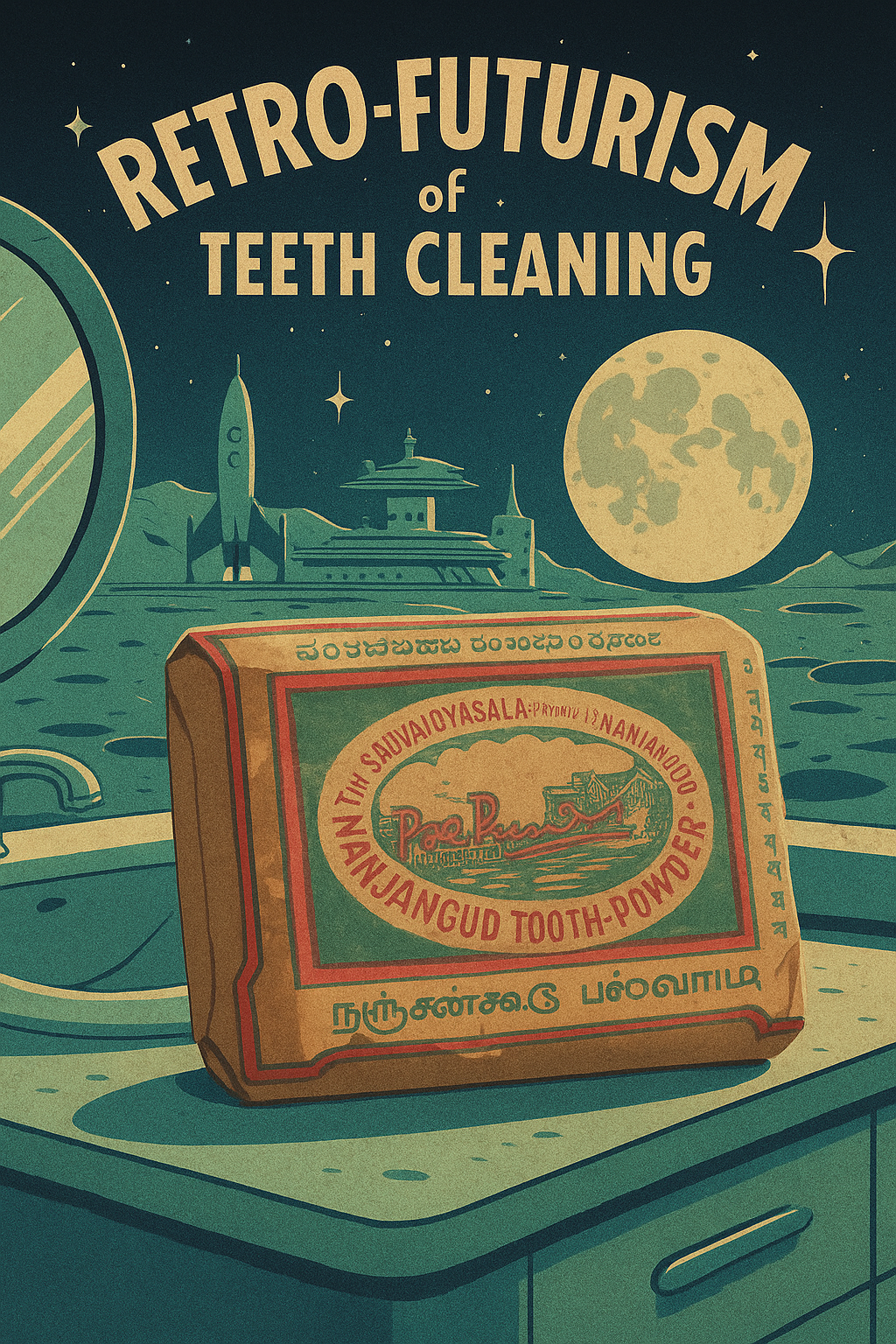
Thus, RHA based dentifrice represents a retro-futuristic approach to oral care—a model for the
future of dentifrice formulations.